
Overseer vs. User vs. Developer: Mapping AI Roles to Training and Certification Obligations
November 3, 2026
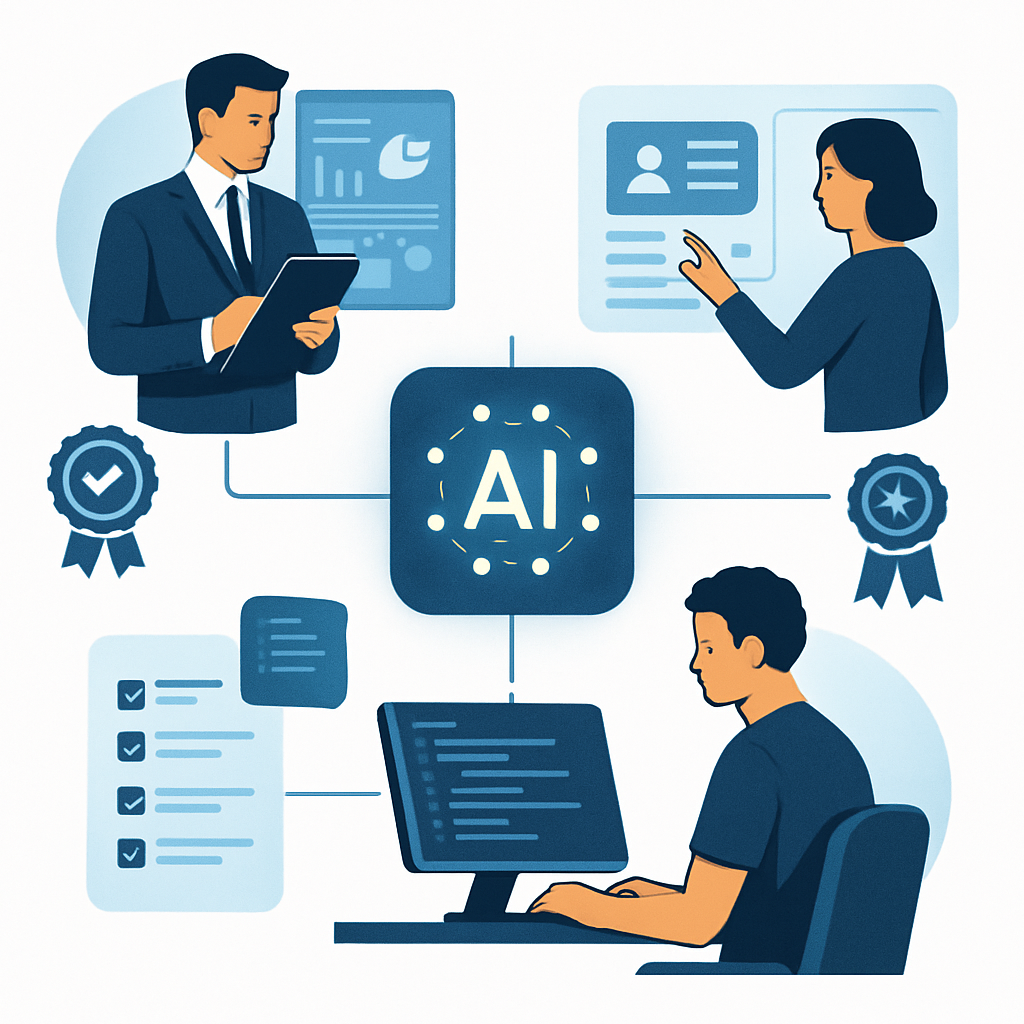 Developers, users, and overseers each carry distinct AI governance obligations that generic training programs rarely address. This guide maps each role to its specific training and certification requirements.
Three Roles, Three Different Sets of Obligations
Regulators and standards bodies writing AI governance rules are drawing sharper lines between the people who build AI systems, the people who use them day-to-day, and the people whose job is to supervise them. That distinction matters for AI roles training certification obligations because conflating the three leads organizations to train the wrong people on the wrong things, leaving genuine accountability gaps that auditors and regulators will find. Getting the mapping right is the first practical step in building a defensible governance structure.
Why the Role Distinctions Matter Before Training Begins
Many organizations assign everyone on a project team to the same AI literacy course and call it done. That approach satisfies the appearance of training without satisfying the substance of oversight. A developer who understands model architecture does not automatically understand how to monitor a deployed system for drift or bias in production. A business user who can operate a tool does not have the judgment to intervene when the tool behaves unexpectedly.
Frameworks such as the EU AI Act and emerging ISO standards are beginning to name roles explicitly, and each named role carries its own obligations. Treating them as interchangeable creates compliance exposure. More practically, it leaves no one clearly responsible when something goes wrong.
The Developer Role: Building with Accountability in Mind
AI developers design, train, and maintain AI systems. Their technical competence is not in question here. What governance frameworks increasingly require is that developers also demonstrate competence in the obligations attached to their role: documenting model capabilities and limitations honestly, maintaining technical documentation that a non-developer can act on, and understanding how their design decisions affect the ability of others to provide oversight.
What Developer Training Should Cover
- Risk classification under applicable frameworks, so developers understand which tier of scrutiny their system will face
- Documentation standards for training data, model cards, and system performance boundaries
- Human-in-the-loop design, including how to build systems that preserve meaningful human intervention points
- Handoff protocols, meaning how technical information gets communicated to the people who will supervise the deployed system
Certification for developers in this context is less about technical skill and more about governance literacy. A developer can be highly competent at building a model while having no structured understanding of what documentation an overseer needs to do their job. That gap is where training adds real value.
The User Role: Competent Operation Within Defined Boundaries
AI users interact with deployed systems to accomplish business tasks. They are not responsible for how the system was built, and they are generally not accountable for supervising the system at the organizational level. Their obligation is narrower: use the system within its stated scope, recognize when an output looks wrong, and know how to escalate.
That narrower obligation does not mean user training is trivial. A user who does not understand a system's known limitations can cause real harm by trusting outputs in contexts the system was not designed to handle. A customer service agent using an AI-assisted response tool, for example, needs to know which categories of inquiry the tool handles reliably and which require human judgment before anything gets sent.
What User Training Should Cover
- The system's intended use case and the boundaries of that use case
- Common failure modes and how to recognize them in practice
- Escalation procedures, including who to contact and under what conditions
- Basic data handling responsibilities relevant to the outputs they generate or act on
User training is typically shorter and more task-specific than developer or overseer training. Certification at this level serves mainly as a record that the organization verified competence before granting access, which is useful both operationally and as an audit trail.
The Overseer Role: Where AI Roles Training Certification Obligations Are Most Demanding
The overseer role is distinct from both developer and user, and it carries the heaviest certification burden. Overseers are the people accountable for monitoring AI systems in production, interpreting performance data, making intervention decisions, and maintaining the organization's ability to demonstrate that human supervision was real and not nominal.
This role is frequently underspecified. Organizations often assign oversight informally to a project manager, a compliance officer, or a department head without giving that person structured training in what oversight actually requires. The result is oversight on paper with no substance behind it.
What Overseer Training Should Cover
- Reading and interpreting system performance metrics, including drift indicators and confidence thresholds
- Understanding the documentation handed off from developers, and knowing what questions to ask when it is incomplete
- Decision criteria for intervention: when to pause a system, when to escalate to developers, and when to report to a regulator or senior leadership
- Audit trail requirements, meaning how to document oversight activity in a way that satisfies internal governance and external review
- Recertification obligations, because oversight competence needs to be revalidated as systems change and regulatory requirements evolve
Overseer certification is not a one-time event. A system updated with new training data or a revised model architecture is not the same system the overseer was originally certified on. Recertification tied to material system changes is how organizations ensure their oversight stays current rather than becoming a credential that describes a system that no longer exists.
Where Role Boundaries Get Complicated
In smaller organizations, one person may occupy more than one of these roles. A data scientist might build a system and then be assigned to oversee it in production. A department head might use an AI tool and also carry formal responsibility for supervising its output.
Wearing multiple hats is not inherently a governance problem. The problem arises when the training and certification for each role are not tracked separately. An individual needs to demonstrate the competencies specific to each role they hold, not a blended version that satisfies none of them fully. Role-level certification records make this visible and auditable.
Cross-role situations also create a specific risk with overseers who are also users. Someone who operates a system every day may develop blind spots about its failure modes precisely because familiarity breeds a kind of selective attention. Structured oversight training counteracts this by giving the person explicit criteria to apply, separate from their operational habits.
Building a Role-Aware Certification Program
Structuring certification obligations around these three roles requires a few concrete steps.
- Map your people to roles formally, not just by job title but by what they actually do in relation to each AI system. The same person may have different roles across different systems.
- Define the competencies each role requires for each system, drawing on the system's risk classification and the applicable regulatory framework.
- Assign training by role, not by seniority or department. A junior developer may need governance literacy training that a senior manager does not, because the senior manager is not in the developer role for that system.
- Track certification at the role-system level, so you know not only that a person has been certified but that they have been certified as an overseer for a specific system, as of a specific date.
- Build recertification triggers tied to system changes, regulatory updates, and the expiration of prior certifications.
Vigilimate AI is built around this structure. The platform treats developer, user, and overseer as distinct certification tracks, maintains audit trails at the role-system level, and flags when recertification is due. That specificity is what turns a training program into verifiable oversight rather than a checkbox.
Start by auditing your current AI governance roles against the three categories above and identifying where your certification records have gaps.
Tags