
The Audit Trail Gap: Why Most AI Governance Platforms Can't Prove Overseer Competency
October 2, 2026
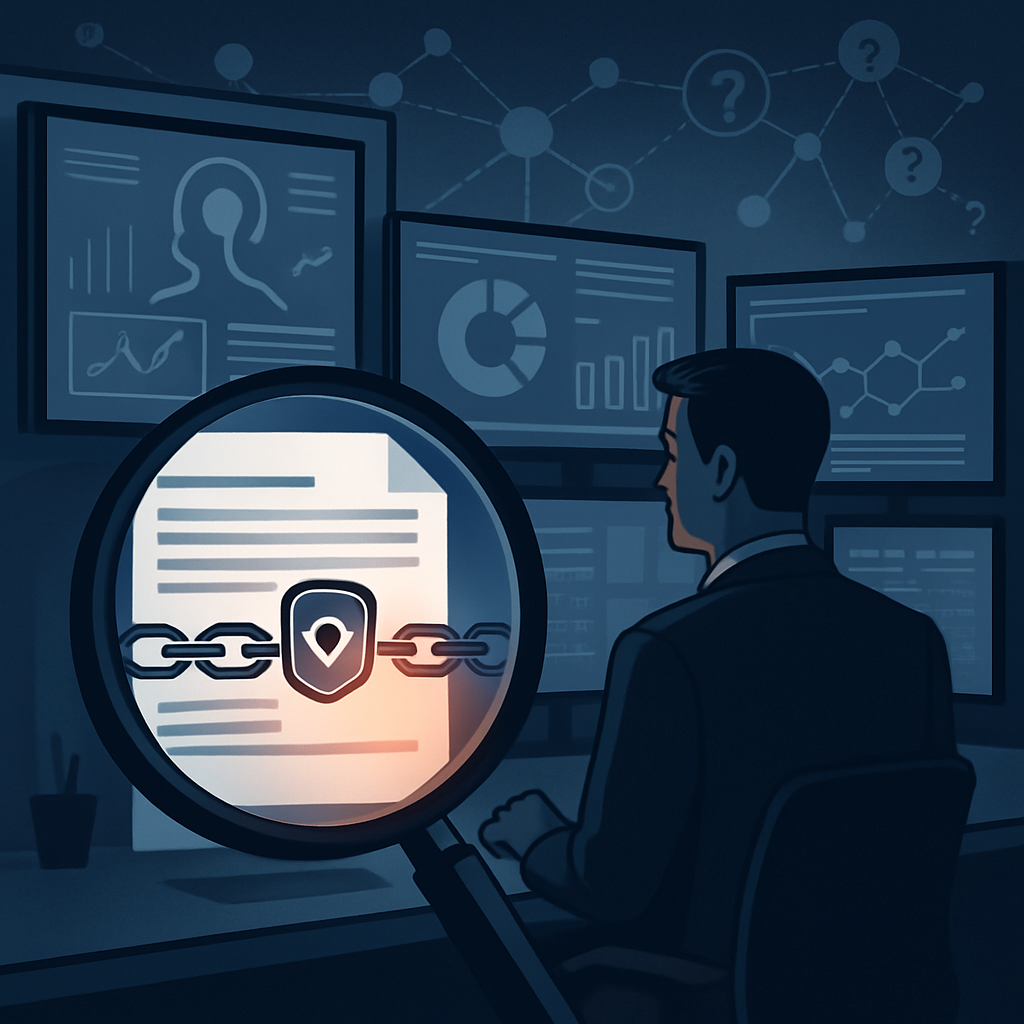 AI governance platforms document what models decide, but almost none can prove the humans reviewing those decisions were qualified to do so. Vigilimate AI explains what a complete audit trail must include on the human side of oversight.
The Audit Trail Gap in AI Governance
Most AI governance platforms produce detailed logs of what a model decided, when it decided it, and whether a human reviewed the output. What they cannot produce is evidence that the human doing the reviewing was qualified to make that judgment. That gap is the central problem in AI governance audit trail competency, and organizations are starting to discover it the hard way when regulators or internal auditors begin asking questions about human oversight.
The logs look complete. The timestamps are there. The approval signatures are there. But the record of whether the overseer understood the risk domain, had been trained on the relevant policy, or was even current on their certification, that part is missing entirely.
What Most Platforms Actually Log
Current AI governance tooling is largely built around model-side documentation. Platforms track inputs and outputs, flag decisions that fall outside defined thresholds, capture the moment a human clicked "approve" or "escalate," and store the version of the model in use at that time. This is useful data.
The problem is that it documents a transaction, not a judgment. A signature on a form proves presence. It does not prove comprehension.
Consider what a serious audit actually asks:
- Did the person reviewing this AI output have documented training on the risk category involved?
- When was that training last completed, and does it reflect the current policy version?
- Was the reviewer certified to oversee this specific type of AI decision at the time of review?
- If something went wrong, can the organization demonstrate the oversight process was carried out by a competent person?
Existing platforms have no architecture for these questions. They were designed to govern the machine, not to verify the human watching the machine.
Why This Is a Documentation Problem, Not Just a Training Problem
Organizations often respond to this gap by pointing to their internal training programs. Employees complete onboarding modules, pass annual compliance reviews, and receive policy updates by email. The assumption is that training happened, therefore competency exists.
That assumption does not hold under scrutiny for two reasons.
First, training completion and competency are not the same thing. Completing a module confirms attendance. A certification that required passing a scored assessment against defined criteria is a different category of evidence. Auditors increasingly understand this distinction, especially in regulated industries.
Second, even where genuine training exists, the record of it is rarely connected to the AI governance system. The training data lives in an LMS. The oversight log lives in the governance platform. There is no link between the two. So when an auditor asks whether the person who approved a high-risk AI recommendation on a specific date was qualified to do so, the answer requires manual cross-referencing across multiple systems, and that process itself introduces uncertainty and delay.
The Shape of a Complete Audit Trail for AI Governance Competency
A complete audit trail does not stop at the model output. It follows the decision all the way through the human review process and surfaces, at the point of review, whether that reviewer was qualified to make the call.
Specifically, a complete record should include:
- Certification status at time of action. Not just whether a person holds a certification, but whether it was current and applicable on the date they performed oversight.
- Training version alignment. Whether the training the reviewer completed maps to the policy version in effect at the time of the review.
- Recertification tracking. Clear records of when recertification was required, when it was completed, and any periods where a reviewer's certification lapsed.
- Role-to-risk mapping. Evidence that the reviewer's certification covered the specific category of AI decision being reviewed, not just AI governance in general.
This is the documentation architecture that regulators in high-stakes sectors, financial services, healthcare, public infrastructure, are moving toward. The model-side log is necessary but not sufficient. It needs a human-side counterpart that can be audited with the same rigor.
The Compounding Risk When Overseers Rotate
Staff turnover makes this problem more acute. In many organizations, the people supervising AI decisions change regularly. A team member leaves, a contractor cycles out, a department reorganizes. The oversight responsibilities transfer, sometimes informally.
Without a system that tracks competency at the individual level and flags when a reviewer's qualifications are approaching expiration or have not been validated, organizations accumulate a quiet liability. The governance platform continues logging approvals. The audit trail looks intact. But beneath the surface, the human-side record is full of gaps that a serious review will surface.
The risk is not hypothetical. An organization that faces regulatory scrutiny or litigation after an AI-assisted decision cannot reconstruct competency records from memory. If the documentation was not created at the time of the oversight action, it does not exist in any form that satisfies an audit.
What Vigilimate AI Is Built to Solve
Vigilimate AI is designed specifically as an oversight layer, what it describes as the "Oversee layer." The core function is verifying that the humans responsible for supervising AI systems are demonstrably qualified to do so, and creating the documentation that proves it.
The platform handles training, certification, and recertification tracking in a way that connects directly to AI governance workflows. When a reviewer takes an oversight action, the system can surface their current certification status and training history as part of the audit record. The approval is not just timestamped. It is linked to a documented competency profile.
That linkage is what transforms a log into a genuine audit trail. It answers the question regulators and legal teams will eventually ask: not just that oversight occurred, but that the oversight was carried out by someone who could demonstrate the knowledge required to perform it.
This is not a module inside a broader governance platform. It is a separate, purpose-built product that fills the gap the model-side tools leave open.
Preparing Before the Audit Arrives
Organizations that are investing in AI governance now, before a regulatory audit or an incident forces the issue, have a real advantage. The time to build the human-side audit trail is before it is needed, not while trying to reconstruct it under pressure.
The practical starting point is an honest assessment of what the current documentation can and cannot prove. Most organizations will find they can answer questions about the model. Fewer can answer questions about the overseers. Knowing that gap exists is the first step toward closing it.
If your current AI governance platform cannot tell an auditor whether the people approving AI decisions were qualified to do so at the time they acted, talk to Vigilimate AI about what a complete audit trail looks like.
Tags